Ghazipur culture __"Epitome of India."
Ghazipur District (U.P.)
is known for its unique cultural harmony and coexistence which is often
referred to as the "Ganga Jamuni tehzib”.Its culture has, thus,
been a composite one. A composite culture is that which successfully absorbs
and harmonizes the impact of various ways of life and traits of civilization.


 Ghazipur also known as Lahura Kashi( Choti Kashi),is the microcosm of
Hinduism, a city of traditional classical culture, glorified by myth and legend
and sanctified by religion; it has always attracted a large number of worshippers
from time immemorial.Being among the holiest city of Hindus, the impact of the
religion is found everywhere in the city- the chanting of bells, the recitation
of Sanskrit hymns, the fragrant flower offerings, the colored powders sold in
roadside shops.
Ghazipur also known as Lahura Kashi( Choti Kashi),is the microcosm of
Hinduism, a city of traditional classical culture, glorified by myth and legend
and sanctified by religion; it has always attracted a large number of worshippers
from time immemorial.Being among the holiest city of Hindus, the impact of the
religion is found everywhere in the city- the chanting of bells, the recitation
of Sanskrit hymns, the fragrant flower offerings, the colored powders sold in
roadside shops. 


The city of Ghazipur is unique in the
architectural, artistic and religious expressions of traditional Indian culture
and is, even today, a living example of this culture. Since ancient times the
natural and cultural landscape of the city has retained an active social role
in contemporary society, closely associated with the traditional way of
life.Numerous festivals are celebrated that preserve the traditional styles of
classical and folk culture.

 Built Heritage
The architectural heritage of Ghazipur is linked strongly since centuries,
to the living cultural and religious traditions of three major religions- Hinduism,
Buddhism, and Islamism .Ghazipur comprises of the old city area, central area
and new area. The unique directional change of the sacred Ganga led to the
development of the ancient city on the banks of the river, facing the rising of
the sun and making thus the Ghats of Ghazipur sacred for all Hindu rituals. 


Natural Heritage
The Ganges considered the most holy river for the Hindus, is especially
sacred in Ghazipur where its course
towards the Bay of Bengal suddenly turns to the north. From its source in the
Himalaya to its mouth in the Bay of Bengal, covering a course of about 2442 km,
only from Ghazipur to Mohammadabad does the Ganga river flow in a crescent
shape meandering from south to north (length 18 km). This peculiar shape is the
result of fluvial process through which the coarser sediments get deposited on
its bank .


Artisan, Dancers
 In Ghazipur, a mela or a fair is often a
religious festival .Melas bring together ritual
functionaries, artisans, craftspeople,
dancers, musicians, speechmakers, dramatists, intinerant
perfomers, sideshows operators, food vendors, merchandise
hawkers, and throngs of parents and children. A fair provides the opportunity
for people from different villages, towns and regions to meet and mix with
others. It brings into contact people of various castes, classes, backgrounds
and interests. Such people mix in a way not usually possible in isolation and
relative homogeneity of their own home, neighbourhood,
or social group. The word mela is
itself derived from the sanskrit root,
'mil', denoting a meeting and mixing. At a fair, this mixing occurs by seeing
each other, joining in processions, worshipping together, forming an audience
for performances, eating food from
a common kitchen, breathing open air, hearing the same sounds.
In Ghazipur, a mela or a fair is often a
religious festival .Melas bring together ritual
functionaries, artisans, craftspeople,
dancers, musicians, speechmakers, dramatists, intinerant
perfomers, sideshows operators, food vendors, merchandise
hawkers, and throngs of parents and children. A fair provides the opportunity
for people from different villages, towns and regions to meet and mix with
others. It brings into contact people of various castes, classes, backgrounds
and interests. Such people mix in a way not usually possible in isolation and
relative homogeneity of their own home, neighbourhood,
or social group. The word mela is
itself derived from the sanskrit root,
'mil', denoting a meeting and mixing. At a fair, this mixing occurs by seeing
each other, joining in processions, worshipping together, forming an audience
for performances, eating food from
a common kitchen, breathing open air, hearing the same sounds.


Festivals and Fares
Ghazipur city and the villages are rich in tradition and their cultural heritage. They are famous for celebrating a variety of vibrant festivals and fares throughout the year.In every parts of Ghazipur’s village festivals and fares are celebrated with much pomp and cheerfulness and are considered some of the greatest events to enjoy. The villagers take these festivals as a platform for social communication and also as a way to get relief from the stress of their daily life.


The major
city and village festivals
include Durga Puja, Kali Puja, Jagaddhatri Puja, Holi, Ratha Yatra, Raksha
Bandhan, Lakshmi Puja, Saraswati Puja, Christmas, Eid-ul-Fitr, Eid-ul-Adha ,
Moharram, etc. Apart from these, there are also a few other festivals
celebrated by all villagers round the year. These festivals include
Janmashtami, Bhaiya dooj, Shivaratri, Akshay Tritiya, Buddha Purnima, Janama
Sthami, Vishwakarma Puja, , Kartik Puja, Basanti Puja, Ramnavami,
Makar-Sankranti (also known as Tila Sankranti), Basant Panchami, etc. etc.
The village festivals are famous all over the district for their bright colours
and lights. People from all over the areas visit there during the festivals to
experience the villagers` wonderful style of celebration.
Muharram in Ghazipur
Ghazipur celebrates all its festivals joyously.


 The general belief is that Muharram is a particular day. In reality, Muharram
is the first month of the Islamic Calendar. It is considered very holy. The
festival of Muharram is celebrated to commemorate the death of Prophet
Mohammad’s grandson Hussein. He had given up his life at Karbala on the banks
of the river Euphrates while resisting anti Islamic forces.
The general belief is that Muharram is a particular day. In reality, Muharram
is the first month of the Islamic Calendar. It is considered very holy. The
festival of Muharram is celebrated to commemorate the death of Prophet
Mohammad’s grandson Hussein. He had given up his life at Karbala on the banks
of the river Euphrates while resisting anti Islamic forces.
Prophet Mohammad himself advocated fasting in the month of Muharram. It is not morally binding, but the belief is that if you observe fast, you will be generously rewarded by Allah. However, it is particularly important to fast on Ashura, the tenth day of the month because it will yield great rewards. The people of Ghazipur generally observe a fast on this day.
On this day which is generally referred to by all as Muharram, the Muslims of Ghazipur are in a very generous mood. Their day begins with a bath. After putting surma in their eyes, they engage themselves in various charitable activities. The Nafl Salat prayers and the Surah Ikhlas are performed religiously. They vow to make friends with enemies and also spend quality time in the company of the Ulemas.



Prophet Mohammad himself advocated fasting in the month of Muharram. It is not morally binding, but the belief is that if you observe fast, you will be generously rewarded by Allah. However, it is particularly important to fast on Ashura, the tenth day of the month because it will yield great rewards. The people of Ghazipur generally observe a fast on this day.
On this day which is generally referred to by all as Muharram, the Muslims of Ghazipur are in a very generous mood. Their day begins with a bath. After putting surma in their eyes, they engage themselves in various charitable activities. The Nafl Salat prayers and the Surah Ikhlas are performed religiously. They vow to make friends with enemies and also spend quality time in the company of the Ulemas.
In the gatherings on the occasion of Muharram, Islamic leaders narrate the
story of martyrdom of Hussein. The most important part of the festival is the
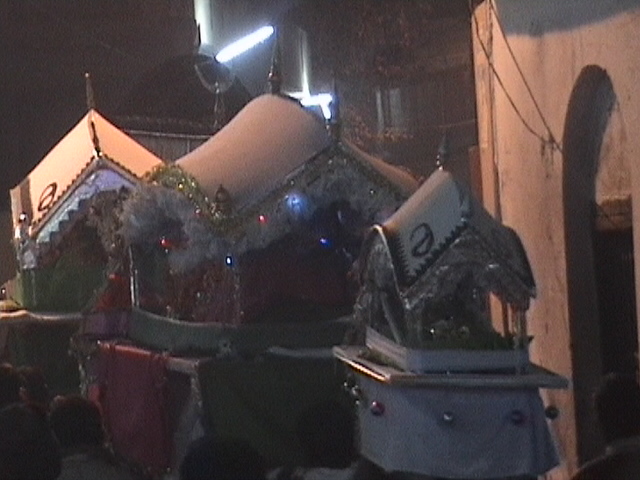
processions. The taziyas or the colorful replicas of Hussein’s tomb are
decorated and taken out and the followers mourn aloud the death of Hussein. In
Ghazipur, the rites of mourning are observed with greater passion.
The time for celebrating Muharram is variable. It is celebrated according to the lunar calendar and so the time fluctuates throughout the season.
The time for celebrating Muharram is variable. It is celebrated according to the lunar calendar and so the time fluctuates throughout the season.
Sufi Saints Contribution in the Cause of Interfaith
Understanding
In Ghazipur Islam was spread, upheld and revitalized by the Sufi saints. The people who loved these men often built beautiful structures around their tombs (dargah), sometimes with an adjoining mosque. These darbars are dargahs as they are called became places of homage and reverence by the Muslims and Hindus.
Sufism was primarily introduced in India for spread of Islam and the Sufi saints tombs emerged as a place of pilgrimage for spread of Islam.


 The numerous Sufi religious establishments in Ghazipur were the major means of spreading Islam and adapting
it to indigenous cultural tradition. Of the various Sufi orders, Muslims of
Ghazipur prominently follow Chistiyya,
Naqshbandiyya, Qadiriyya and Suhrawardiyya orders.
The numerous Sufi religious establishments in Ghazipur were the major means of spreading Islam and adapting
it to indigenous cultural tradition. Of the various Sufi orders, Muslims of
Ghazipur prominently follow Chistiyya,
Naqshbandiyya, Qadiriyya and Suhrawardiyya orders.
For centuries the Hindus accepted Sufi shrines as symbol of communal harmony. A large number of them offer prayers at the tombs of the Sufi saints.
The Sufi saints wrote in local language or even dialect and hence were much closer to the people. Popularity of these Sufi saints is indeed tremendous.
In Ghazipur Islam was spread, upheld and revitalized by the Sufi saints. The people who loved these men often built beautiful structures around their tombs (dargah), sometimes with an adjoining mosque. These darbars are dargahs as they are called became places of homage and reverence by the Muslims and Hindus.
Sufism was primarily introduced in India for spread of Islam and the Sufi saints tombs emerged as a place of pilgrimage for spread of Islam.


For centuries the Hindus accepted Sufi shrines as symbol of communal harmony. A large number of them offer prayers at the tombs of the Sufi saints.
The Sufi saints wrote in local language or even dialect and hence were much closer to the people. Popularity of these Sufi saints is indeed tremendous.
The famous Sufi saints who contributed greatly in propagating the message of
Islam in Ghazipur District especially ,Hazrat Malik Mardan[ Shadiabad ,1029
A.H.],Malik Bahri,Sayed Tajuddin sabzwari [ Death ,Tajpur dehma .1264 A.D.
],Makhdum Tajuddin Abbasi [Saidpur bhitri . 1330 A.D.],Amir Masud Ghazi [ Ghazipur.1330
A.D.]Makhdum Jalal [1330 A.D.],Sayd Jamal susandwi [ 1331 A.D.],Sayd Jiraan
shaheed urf Judan shaheed [ 1330 A.D.],Khwaja Moinuddin Qattal [Zahoorabad.
1330 A.D.], Shaikh Ghulam Mustafa Adhami [ Bahariabad.1332 A.D.],Shaikh Mohd.Saleem
Muhammadabadi[1331A.D.],Makhdum shah Ahmad Bin jala [ Chaukiya.1335
A.D.],Shaikh Bandagi Fareed [Dhrammarpur],Shaikh Shah Shahabuddin chisti [Norruddinpura.722Hijree],Makhdum
Aanand peer [ Shah nind ,Mohammadabad.1475 A.D. Death],Sayd Shah Numud [saidpur
from holy man,sayd shah numud,Ain e Akbari,trans.by Blochman p.382,Oldham,part
1,P.81],Makhdum Abul Fateh Chishti [1510 A.D.],Makhdum Shah Ahmad zamanvi [1525
A.D.],Sayd Shah Barkhurdar abbasi [ Shamashan ghat,roohi mandvi.1510
A.D.],Shaikh Mahmood Faruqui [ 1512 A.D. ], Shaikh Fakhruddin Madari [1536
A.D.death],Sayd Shah Bahlol urf Phool shah [ zahoorabad,1490 A.D.],Shaikh Shah
Mohd.Ghaus [ birh, Zahoorabad,1492 A.D.,Death Gawalior,1575 A.D. ],Shaikh
Akhtiyaruddin [ Saroli urf pahetiya,1510 A.D. ],Shaikh Jamal Ahmad Makki [
Yusufpur Mohammadabad,1526 A.D. ],Shaikh Shah Junaid Qadri [ Saklenabad,1526
A.D. ],Shaikh Jamaluddin Ahmad [Sihani,dildarnagar,1526 A.D. ],Mulla Ruknuddin
Bahariyabadi [ death 1684 A.D. ],Shaikh Samman [ death Saidpur,1527 A.D. ],Shaikh
Yaqoob Chisti [ 1527A.D.],Shaikh Ishaaq chishti [ death Shahipura,Lautan
imlee,1625 A.D.],Shaikh Usman Chishti [
zamania,1610 A.D. ], Shaikh Roohulla sarolvi [Roohi mandvi,1621 A.D.],Shaikh
shah Bandagi Jamal [ death saidpur bhitri ,1621 A.D.],Sayd Meer Hasan urf Miran
shah Bal-jatti [ Mohammadabad ,1639 A.D.],Sayd Ahmad Bheekh urf Bilmeek Shah [
1622 A.D.],Sayd Shah Mohd.Afzal Saidpuri alis Allahabadi [ birth Bhitri 1628 A.D. –Death Allahabad
,1763 A.D.],Shaikh Salahuddin urf Dadan miyan [1650 A..D.],Sayd inayatullah
nunahrvi [ 1625A.D.],Sayd Mohd.Waris Rasulnuma Nonahrvi summa Bnanrsi [ 1676
A.D. ],Shaikh Mohd.Fasih [ 1222 Hijri ],Sayd Shah Abul ghaus Garam Diwan [
death 1178 Hijree],Sayd Shah Fakhruddin [ Dhawa 1979 A.D.]Shaikh Ziauddin peer
[ Mahajan toil,1810 A.D.],Shaikh zahorulhaq Mohd.Abdul Aleem Aasi [ 1832 – 1335
Hijri],Haji Didaar Ali Khan [ Barbrahna1295,Hijri].
Hazrat Abul Fateh Chishti and Hazrat Shaikh Yaqoob Chisti who brought the Chishtiyya order and Hazrat
Shaikh Junaid ahmad usmani peer qadri
,who brought Qadriya order to Ghazipur and they are considered as the most
outstanding Sufi saints in eastern
U.P.Both dargahs are the most holy places for Muslims. The Dargahs are equally
holy for Hindus and other religion followers. The shrines are equally prayed by
Hindus. ‘urses are a yearly celebration of the death date of Sufi saints.